


Quantum computing is going to break most of the encryption that holds the modern world together. That’s true, and it matters, but it’s only the start of the story. The harder question is which technologies actually answer this threat, what each one does, what it demands of you, and who it’s really meant for. Because “quantum-safe” isn’t one thing. It’s a single label draped over a handful of distinct technologies that solve different problems in different ways. Some technologies replace the math behind today’s encryption with algorithms a quantum computer can’t crack. Others use the laws of physics to distribute keys or generate true randomness. They are not interchangeable, and a lot of confusion, along with a good chunk of wasted budget, comes from treating them as if they were.
The following blog will help you understand what each technology is and what kind of organization it’s built for. By the end, names like PQC, QKD, and QRNG will be clear, and you’ll know which of them belong in your plan.
what are we defending against?
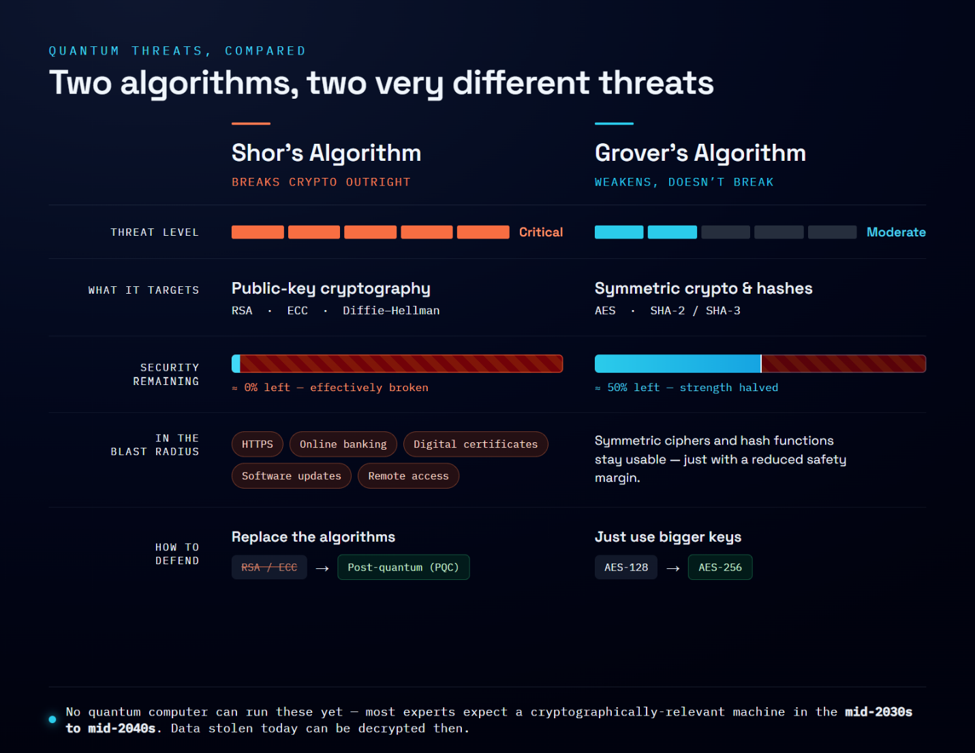
Why Act Now?
If quantum computers are still years away, why are organizations already preparing?
The answer is Harvest Now, Decrypt Later (HNDL). Attackers can capture encrypted data today, store it for years, and decrypt it in the future when quantum computers become powerful enough.
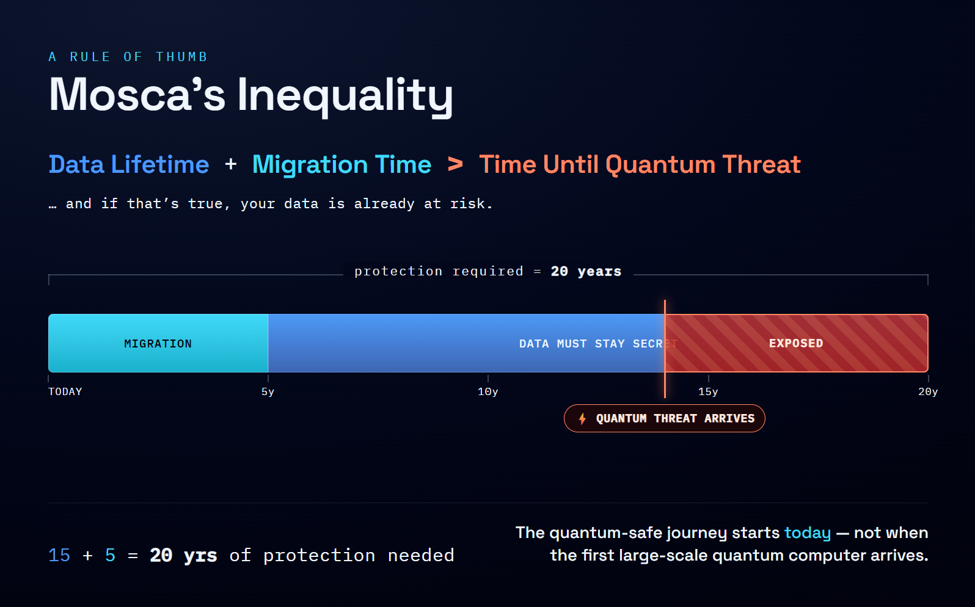
A Simple Reality Check:
Mosca’s Inequality highlights the urgency of threat response
The core: Post-Quantum Cryptography (PQC)
If you remember one thing, remember this: PQC is the journey. Everything else is supporting cast. PQC is a set of new mathematical algorithms built on problems believed hard for both classical and quantum computers structured lattices, hash functions, and error-correcting codes. The crucial property is that PQC runs on the classical hardware you already own. It is a software and firmware change not a new category of machine. It directly replaces the RSA and ECC that Shor’s algorithm breaks.
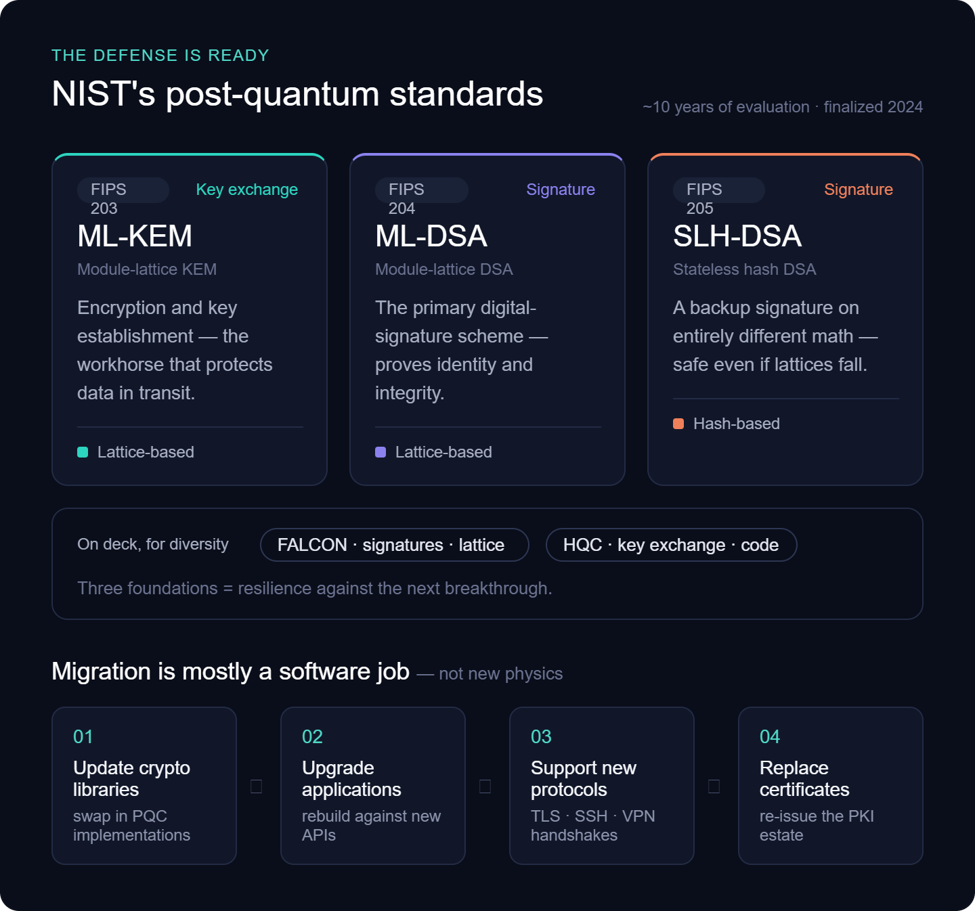
Governments, financial institutions, healthcare providers, telecom operators, and cloud providers are leading the transition. Major technology companies such as Cloudflare, Google, and Apple have already begun deploying hybrid post-quantum cryptography to protect billions of users
| What it needs: | Who’s interested: |
| Mostly software and firmware updates. That means swapping in updated cryptographic libraries, getting your protocols to support the new algorithms (like hybrid TLS), and re-issuing the certificates across your PKI. The new keys are bigger and take more computing power, so if you’re running this at high volume, dedicated hardware to speed things up can be worth it. | Ultimately, every organization that relies on secure communications will need to adopt PQC. The earliest adopters are governments, financial institutions, healthcare providers, telecom operators, and cloud service providers. Major technology companies such as Cloudflare, Google, and Apple have already started deploying hybrid post-quantum cryptography to protect billions of users. |
The supporting cast:
Symmetric hardening:
Not a new technology, just configuration. Move to AES-256 and SHA-384/512 and the Grover threat is effectively handled. Cheap, fast, and easy to overlook.
Quantum Random Number Generators (QRNG):
If PQC is the lock, QRNG helps create better keys for that lock. Quantum Random Number Generators (QRNGs) use quantum phenomena, such as the behavior of photons, to generate truly random numbers. These random numbers are used to create cryptographic keys, making them less predictable and therefore more secure.
QRNG is not a replacement for PQC. Instead, it complements it. Even the strongest encryption algorithm can be weakened if the keys protecting it are generated from poor or predictable sources of randomness. For most organizations, QRNG is not a necessity. Modern operating systems and hardware already provide strong sources of entropy. QRNG becomes most valuable in environments where highly trusted, certified, or hardware-rooted randomness is required, such as certificate authorities, hardware security modules, and highly regulated industries.
| What it needs: | Who’s interested: |
| A piece of hardware, either a chip, a PCIe card, or a rack-mounted appliance or you can skip the hardware entirely and use a software or cloud service that delivers entropy on demand. | Certificate authorities, HSM manufacturers, banks, defense, automotive and IoT makers (where chip-scale QRNGs now fit on a single CMOS), data centers, and blockchain platforms. |
Quantum-safe Hardware Security Modules (HSMs):
If cryptography is the lock, the HSM is the secure vault where the keys are protected. A Hardware Security Module (HSM) is a tamper-resistant device designed to generate, store, and use cryptographic keys while keeping them protected from unauthorized access. It provides the hardware root of trust for many critical security systems.
HSMs are also where PQC and QRNG often come together in real-world deployments. As organizations prepare for the quantum era, HSM vendors are adding support for post-quantum algorithms and quantum-safe key management capabilities. Leading vendors, including Thales, Entrust, Utimaco, Marvell, Crypto4A, and IBM, are introducing PQC capabilities into their platforms. However, the industry is still evolving supporting PQC algorithms is one step, but creating fully quantum-safe hardware architectures is a longer journey.
| What it needs: | Who’s interested: |
| A hardware appliance running firmware that supports the new PQC algorithms, ideally one validated to FIPS 140-3 Level 3, the standard that certifies it’s tamper-resistant enough to be trusted with your keys. | Banks, payment processors, certificate authorities, PKI operators, and any regulated enterprise with serious key-management obligations. |
The niche and the frontier:
Quantum Key Distribution (QKD):
Quantum Key Distribution (QKD) is one of the most well-known quantum security technologies, but it is often confused with Post-Quantum Cryptography (PQC). They solve different problems using completely different approaches. PQC relies on new mathematical algorithms designed to resist quantum attacks. QKD, on the other hand, relies on the laws of physics.QKD uses quantum properties of particles, such as photons, to securely exchange encryption keys. Because measuring a quantum state changes it, any attempt to intercept the communication can be detected.
This sounds like the ultimate security solution, but QKD has practical limitations. It requires specialized hardware, dedicated optical links, and has distance limitations. It also cannot authenticate communicating parties by itself, meaning it still depends on traditional cryptography for authentication. Because of these challenges, QKD is generally viewed as a specialized technology for very high-value communication links rather than a replacement for enterprise-wide cryptography.
| What it needs: | Who’s interested: |
| QKD requires dedicated quantum hardware, including photon sources and detectors, along with specialized infrastructure such as dark fiber or free-space optical links. | QKD is primarily being explored by governments, defense organizations, central banks, and critical infrastructure operators. Its strongest use is protecting specific, high-value communication links where the cost and complexity are justified. |
Satellite QKD:
Traditional QKD relies on fiber networks, but fiber has a major limitation: it cannot easily support secure quantum communication across oceans and very long distances. The solution is to move QKD into space.
Satellite QKD uses quantum communication payloads on satellites to distribute encryption keys between distant locations. One example is the Jinan-1 microsatellite, which demonstrated real-time quantum key distribution and enabled secure communication between Beijing and a ground station in South Africa approximately 12,900 km.
| What it needs: | Who’s interested: |
| Low-Earth-orbit satellites with QKD payloads, optical ground stations, and clear-weather line of sight. | Nation-states, space agencies, defense, and anyone needing intercontinental secure links. This arena is heavily geopolitical, and China currently leads. |
What About Quantum Networks?
Quantum networks and the quantum internet represent the long-term future of quantum communication, using technologies such as quantum repeaters and entanglement distribution to connect quantum systems over global distances.
However, these technologies are still largely in the research phase. For organizations planning their quantum-safe journey today, the priority remains practical: migrating to Post-Quantum Cryptography (PQC), strengthening key management, and preparing existing infrastructure for a quantum-resistant future.
The Foundation of the Quantum-Safe Journey:
The most overlooked part of quantum readiness is also the one that determines success: knowing where cryptography exists and having the ability to change it. Before organizations migrate to Post-Quantum Cryptography (PQC), they need visibility into where cryptography is being used from TLS and VPNs to applications, databases, firmware, certificates, and third-party systems.
This is where a Cryptographic Bill of Materials (CBOM) becomes essential. Like SBOM, CBOM provides an inventory of cryptographic algorithms, keys, certificates, and dependencies, helping organizations understand their exposure and prioritize migration.
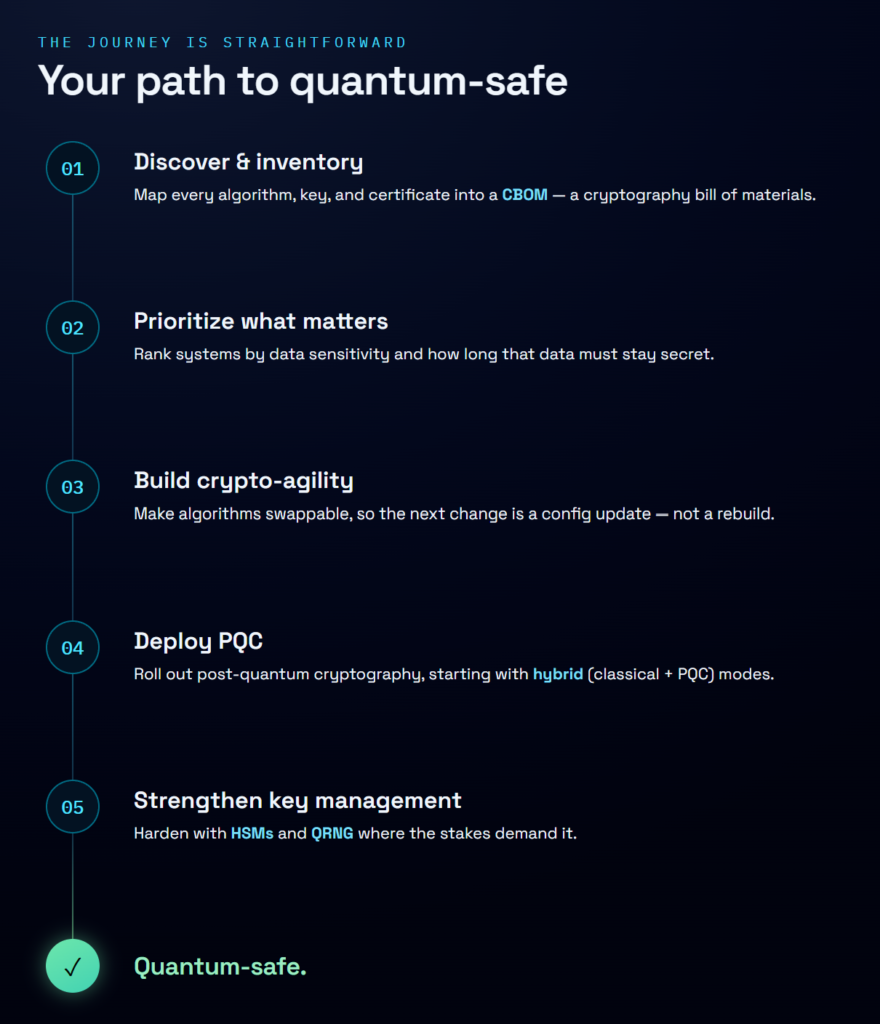
The other critical capability is crypto-agility, the ability to replace cryptographic algorithms through configuration changes rather than costly redesigns. This ensures organizations are prepared not only for quantum threats but also for future changes in the cryptographic landscape.
The key takeaway is simple:
PQC is the main path to quantum safety, while CBOM and crypto-agility are what make migration possible. The goal is not to buy a quantum solution it is to build an organization that can adapt its cryptography as technology evolves.
About Author:
Noori Mohammad is a cybersecurity expert whose work sits at the intersection of security and quantum computing. Over more than 25 years in the industry, she has led cybersecurity initiatives at global organizations including Microsoft, IBM, Citibank, Royal Bank of Canada, ABSA, First National Bank, and Tata Consultancy Services. She holds a master’s degree in cybersecurity, a CISSP certification, and quantum certifications from MIT, among other credentials, and is currently pursuing a PhD in quantum physics. That combination gives her a rare, practical view of how cybersecurity and quantum technologies are reshaping one another.you can get in touch with author at noorim@doyencyber.com
Sources and Further Reading:
https://docs.google.com/document/d/173zV3oncjGiR6gE-rhGmIjnblxIn8lkcQpiaFZ_kASw/edit?usp=sharing